Insights
— Platform
AI tagging: what it structures, what it does not decide.
AI tagging describes what is in an image. It does not decide what the image is for. Explanations of AI tagging usually argue accuracy instead – how many tags are right, how many are wrong. Accuracy is the smaller question. A wrong tag makes an asset harder to find. A recorded decision nobody made changes what a team believes was agreed.

Mathias Buschor
Co-Founder at moodcase
•
6
min read

AI tagging produces description, not judgment
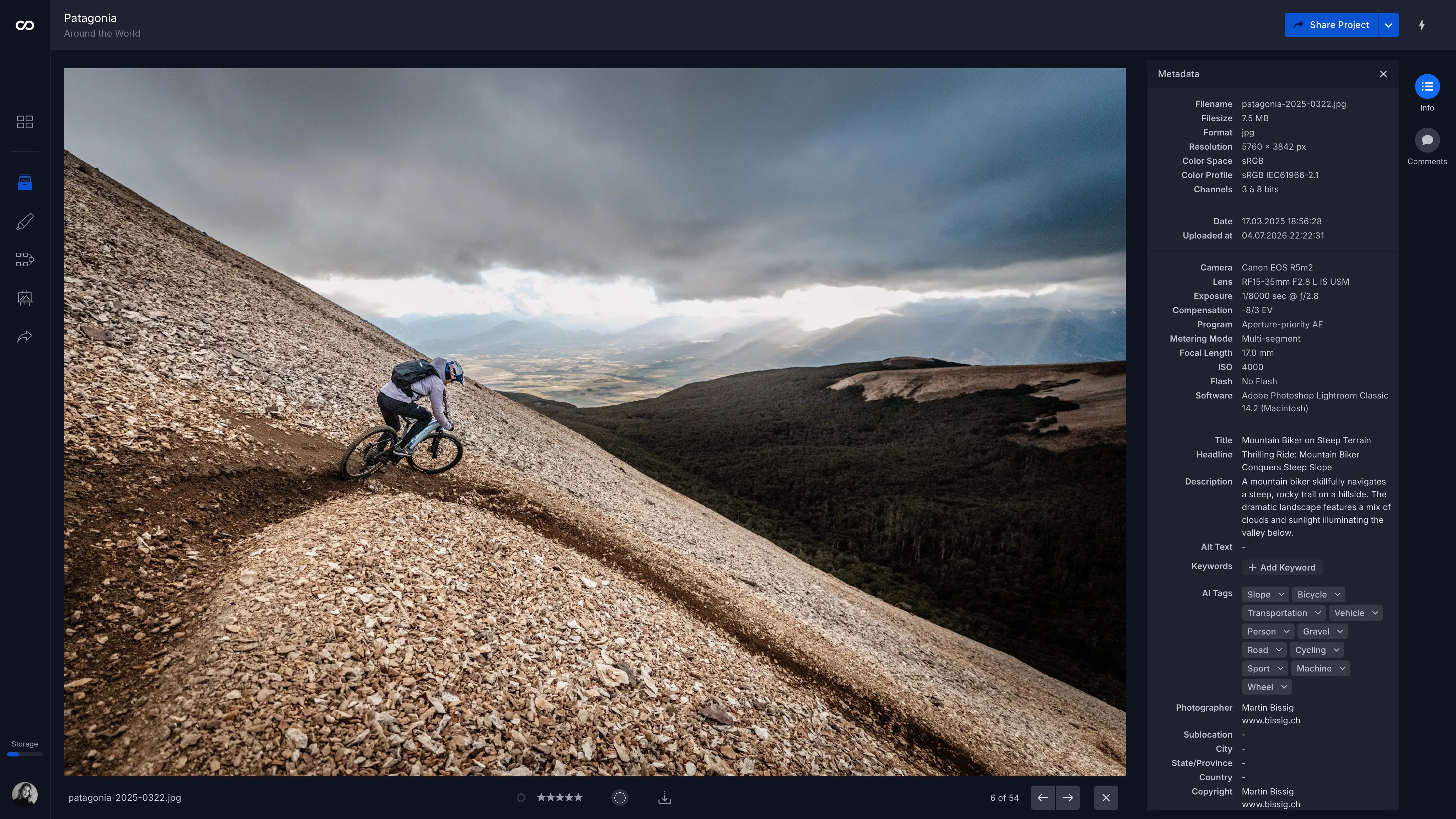
What an auto-tagging model returns is a set of attributes read from the pixels: objects, scenes, dominant colors, text found in the image, whether faces are present. These are statements about what the image contains. Anyone can check them by looking at the asset.
At volume, that is worth having. A library growing by thousands of assets a year – a pattern common to team workspaces – outpaces manual keywording, because new work arrives faster than anyone schedules time to describe it. Assets nobody described are not lost. They are unreachable by search, which in a large library amounts to the same thing.
In moodcase, AI Tagging suggests tags as assets enter the library on team plans. Description starts at upload rather than waiting for a round that never gets scheduled.
What a model cannot read from the pixels is a different class of information. Which campaign this asset belongs to. Whether it was approved for release. What the license permits, and until when. Who may see it.
None of that is in the image. It is the record of agreements people made around the image, and no amount of looking at the file reveals it.
The difference shows on a single asset. A model can report that the frame contains a building at dusk. It cannot report that the image is licensed for one region and one year, or that a colleague approved it for release last March.
The accuracy debate is the smaller one
Published treatments of AI tagging argue accuracy. They list where models do well – recognizable objects, standard product shots, legible text – and where they fail: abstract compositions, unusual treatments, small brand marks, anything whose meaning depends on knowing the brand. That is a question of degree. It shifts with every model generation and will keep shifting.
Accuracy errors are also recoverable. A wrong tag costs one search. A missing tag costs one asset that surfaces later than it should. Correct the metadata and the library is right again, with no consequence outside it.
Errors of authority behave differently. Suppose a system marks an asset as cleared for use and nobody made that call. The asset carries the claim out of the library. It appears in a campaign, and whether it was ever cleared becomes a question after publication, when correcting the metadata no longer helps.
The two kinds of error do not belong in the same conversation. One is a retrieval cost, paid once, inside the system. The other is a commitment made on someone's behalf.
Where description ends and decision begins
The practical division is straightforward. A model writes attributes: tags, descriptions, detected content, technical properties. People write states: what was approved, what stage the asset has reached, who may reach it. Attributes describe the asset. States record what was decided about it.
Keeping the two apart is what makes machine-written tags safe to rely on. Nobody treats them as authority, so an imperfect tag stays a search problem. Retrieval improves as the model improves. Nothing downstream depends on the model having been right.
That also changes what a team is asking when it evaluates tagging quality. The question is not whether tags are correct enough to act on. It is whether they are useful enough to find things with. The second threshold is met far earlier than the first.
In moodcase on team plans, AI Tagging suggests attributes, Asset Metadata holds the structured fields, and Global Search returns assets by attribute across the workspace rather than by folder path. Workflow Statuses, also on team plans, are set by the people responsible for them. The library answers "which assets look like this" with metadata. It answers "what stage this asset has reached" with a state someone recorded.
Better models do not change what a decision is
It is tempting to read this boundary as a limitation of current systems – something the next model generation absorbs. It is not. The boundary is not about capability at all.
An approval is not a fact waiting to be detected. It is a fact created by a person with the standing to create it. A model that inferred approvals correctly every time would still not have made one. The value of the record is not that it matches the state of the world. The value is that it identifies who committed to it, and when.
The same holds for access, which records a choice about who is allowed in, and for usage rights, which record what a party agreed to permit. These are undertakings, not observations. Accuracy never converts description into decision, however far accuracy goes.
That has a practical consequence for how a visual library should be structured. Retrieval can absorb every improvement a model offers, and should. What a person decides should be built so that no improvement changes who holds authority over it. Not as caution about the technology. As an accurate description of the two kinds of information.
Systems that blur the two tend to blur them in one direction. They let a model infer a state, present the inference as a record, and leave the team to discover later that nothing was ever decided. moodcase visual asset management keeps them apart: approvals and workflow states are recorded, not inferred, and access is defined rather than derived. The tagging can keep improving. What the library records about approval and access does not move with it.
Who this matters to
This matters when a library is too large for manual retrieval and shared enough that other people act on what it says. It matters less for a small library held by one person who made every agreement and remembers it. Description can be automated. The decision stays with whoever is accountable for it.
Visual assets need more than a folder. See how moodcase handles the full workflow.
Try all features for 7 days. No credit card required.
AI Tagging
Metadata
Search
Creative Teams
RELATED

Visual Asset Management is not cloud storage.
AI tagging describes what is in an image. It does not decide what the image is for. The question is authority, not accuracy.

Approval is a decision, not an assumption.
Approval is a decision someone makes, not a silence you interpret. The gap between the two surfaces months later.