Insights
— Platform
The approval record's first reader is not an auditor
Approval records are shaped for scrutiny that may never come. Complete, chronological, exportable, built to survive a review. Meanwhile someone opens the same work on a Tuesday and needs one thing: was this decided, and by whom. That reader arrives every week, and almost nothing about the record is built for them.

Mathias Buschor
Co-Founder at moodcase
•
4
min read

The gap is not detail or completeness. It is purpose. An evidentiary record proves a decision happened. An operational record says what was decided, so nobody has to decide it again.
Most teams keep the first and assume the second comes with it. The assumption is easy to make, because both look like a list of who did what, in order, with timestamps. It does not follow. The cost lands on people who never name it, because what they experience is not a missing record. It is a question they have to ask twice.
Nobody opens an approval record for an audit
The list of moments when someone actually reaches for one is short. No entry on it is a compliance review.
Work changes hands. Someone is on leave, someone joins mid-campaign. The person picking it up needs to know which decisions are already closed before touching anything.
An asset comes back into play. A photograph used once is proposed again months later, and the question is not only whether it was approved but what it was approved for.
Something is about to go out. A last check before a print run or a launch. The reader is looking for a reason to stop and needs to establish quickly that there is not one.
None of them wants a history. They want a current answer, in the same place as the work. An audit trail hands them a history and leaves them to derive it.
What an unreadable record costs
Settled work gets reopened. Not because anyone disputes the outcome, but because nobody can find it fast enough to trust it. A designer asks whether the second crop was approved or only discussed. A marketer asks whether the cleared image is the one now in the deck. Somebody scrolls a thread, finds an ambiguous line, and asks the client again.
Each is small. Together they are why work finished in March still generates questions in June. The decision was made. The record of it was not usable.
This is where the compliance framing does quiet damage. A record built for an audit is optimised for completeness, and completeness is the enemy of retrieval. Everything is in there, which is exactly why nobody finds the line that matters.
What happened and what is true now are different questions
An evidentiary record answers the first. An operational one has to answer the second, and the two come apart the moment a decision is revised.
The history says one crop was approved on the eleventh and a different crop on the nineteenth. Both are true. Both are recorded. Neither tells you which file to use today. Someone has to read the sequence and interpret it, and interpretation is the failure the record was supposed to remove.
The narrower question also has a shorter answer, which matters more than it sounds. A record that resolves in one line gets read. A record that requires reconstruction gets skipped. A skipped record behaves like no record at all, with one difference: everyone believes it exists, so nothing gets built to replace it.
That resolves into one design decision: whether the record sits beside the work or on it. Beside it, someone has to know it exists and choose to go there, which in practice means it is consulted after something has gone wrong. On it, opening the asset shows its state. The decision is not retrieved. It cannot be missed.
The handover test
The cost is clearest at a handover, when the record is the only thing between a new person and decisions they cannot see. Where it is unusable the handover becomes a meeting, and an organisation that wrote everything down transfers it verbally anyway. What is written survives the handover. What is narrated survives until the next one. If work can change hands without a meeting to explain its state the record is operational, and if it cannot, the state lives in someone's head.
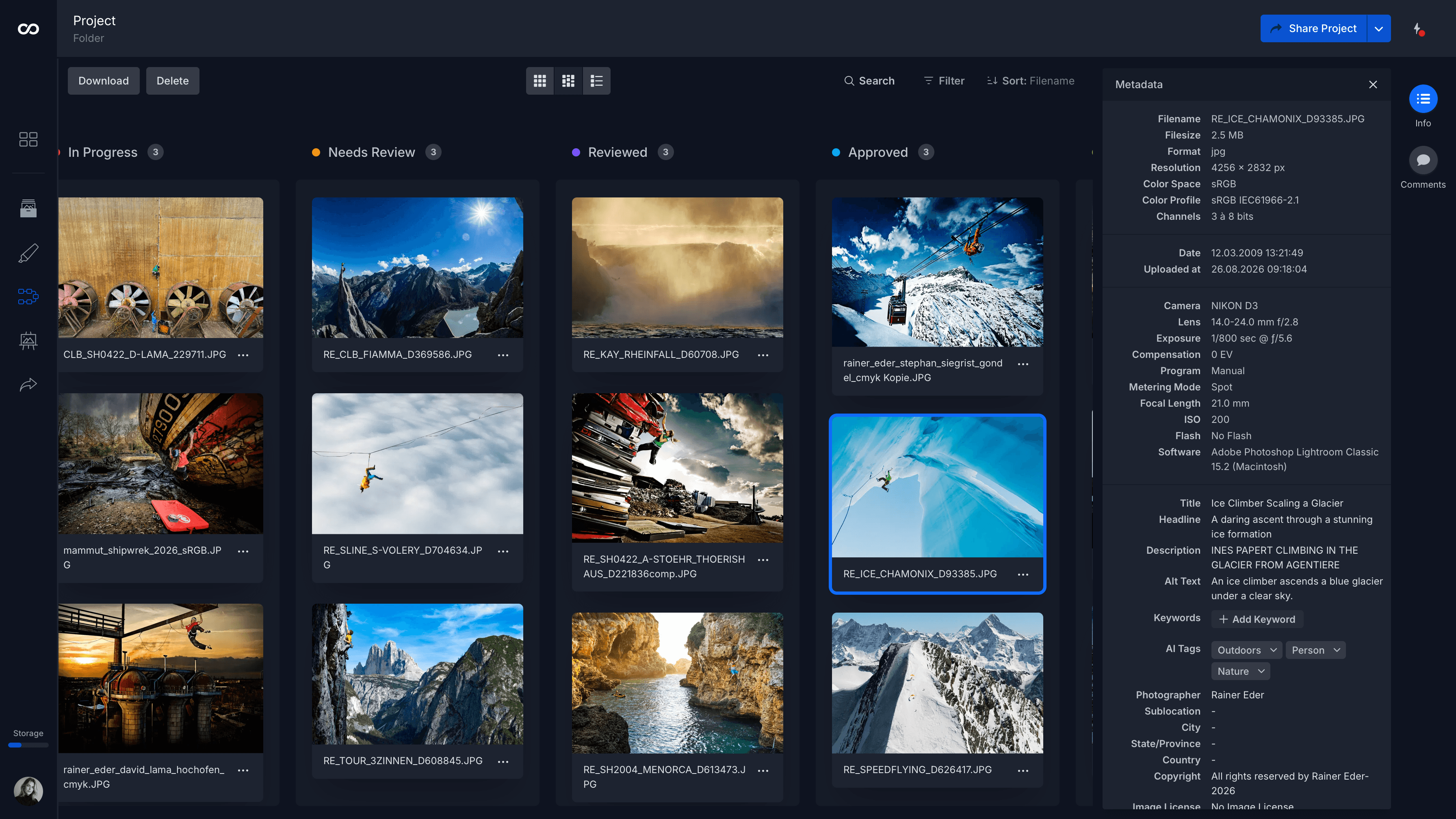
What moodcase does with this
Approvals and workflow states are recorded rather than inferred. The state sits on the asset, not in a separate log to be consulted afterwards, so opening the work shows what was decided about it. Activity and audit logs exist across all plans for the evidentiary case, and workflow statuses in team plans carry the operational one.
That split is deliberate. The audit trail keeps its job. It stops being asked to do one it was never shaped for.
Where this fits
If approvals live in threads and inboxes, the first symptom is not a compliance failure. It is repetition: the same question asked twice, the same crop re-approved, the same clearance re-checked.
Visual assets need more than a folder. See how moodcase handles the full workflow.
Try all features for 7 days. No credit card required.
Approval
Metadata
Missing Context
Marketing Teams
RELATED

Approval is a decision, not an assumption.
An approval record is built for an audience that rarely opens it, and read by one that needs it every week.

The image is cleared. For what, and until when?
An approved image is not automatically a usable image. Approval records acceptance. Permission records what the use may be.