Insights
— Platform
Visual asset management without DAM overhead.
Teams managing 5,000 to 50,000 visual assets need metadata, access control, feedback on the image, and delivery inside the system. Enterprise DAM provides this at enterprise scale. For a studio of five or an agency of twelve, the structure is right but the shape is wrong. moodcase is built for this gap.

Mathias Buschor
Co-Founder at moodcase
•
6
min read

What enterprise DAM is designed for
Enterprise DAM platforms serve organizations managing visual assets across departments, regions, and distribution channels. Systems in this category handle brand portals, compliance workflows, automated distribution to content management systems, multi-level governance, and integrations across enterprise creative suites.
These capabilities exist because large organizations need them. A company distributing brand assets to 500 users across 12 markets has different requirements than a photography studio managing 200 client projects per year.
The mismatch appears when a smaller team evaluates DAM and encounters a system built for a different operational reality. The team's need is real: the shared drive is no longer enough, folder structure is breaking, feedback is scattered, and delivery is disconnected from the project. But the enterprise DAM category answers that need with infrastructure the team will never use.
What structured visual asset handling looks like without DAM
Structured handling does not require enterprise architecture. It requires a system that treats visual assets as more than files in a folder. In moodcase, this means five specific things.
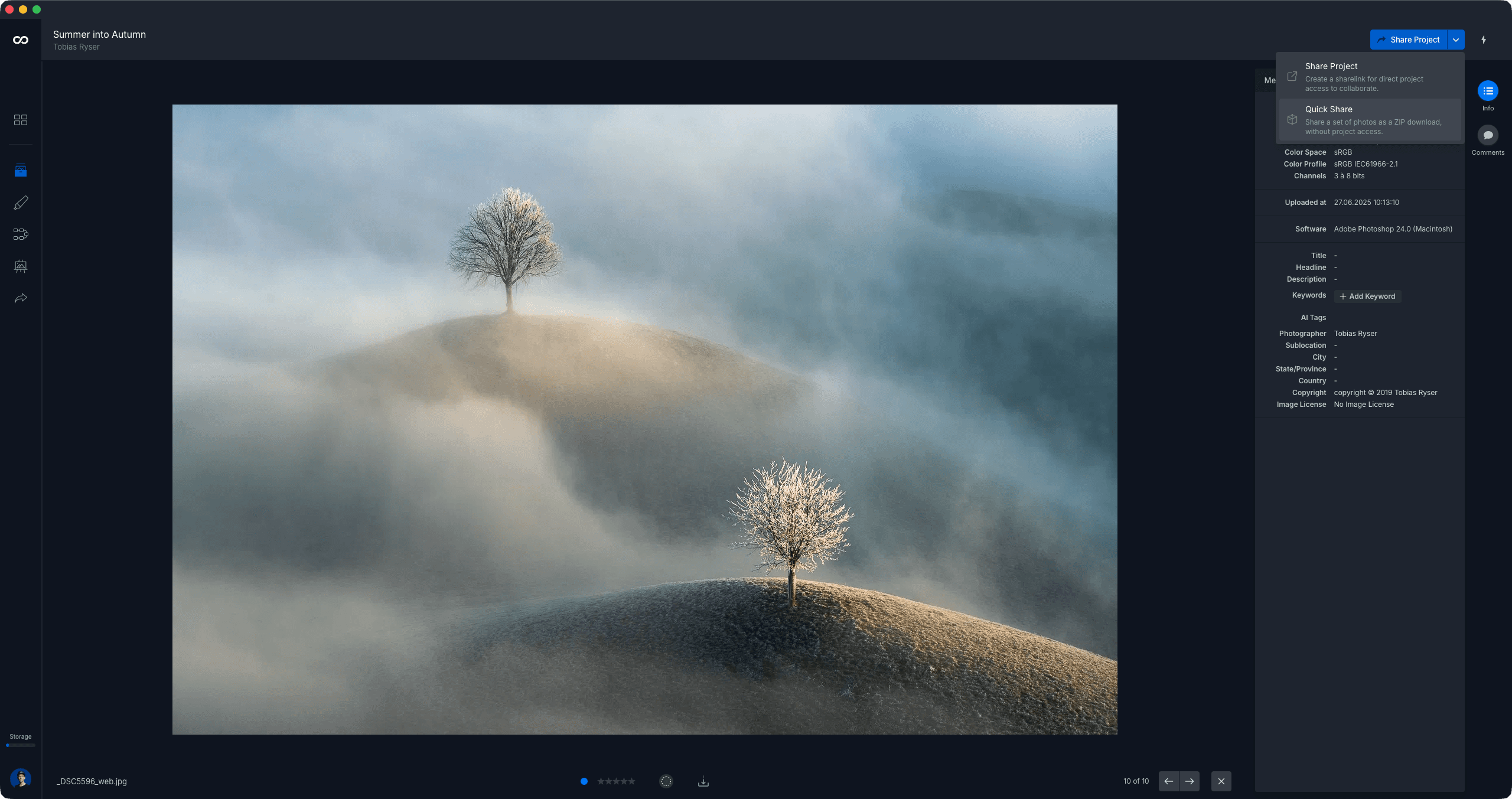
Assets carry metadata, not just filenames. Keywords, AI tags, color labels, workflow status, ratings, copyright, usage rights, location. On team plans, moodcase global search retrieves any asset across the workspace by any of these attributes.
Decisions are recorded on the asset. Review feedback, annotations drawn on the image, threaded comments, approval states. The history of what was decided about a visual asset stays with the asset. Not in an email thread. Not in a spreadsheet. On the image itself.
Access is defined, not inherited from a shared link. Granular link permissions control who sees what. Password-protected galleries, link expiration, role-specific visibility. Each view is controlled at the gallery level without duplicating files.
Delivery is part of the system, not a separate step. Branded galleries with controlled downloads, custom domains on higher plans, Quick Share ZIP for direct file handoff.
Structure survives beyond the project. Assets persist with their metadata and context after the project ends. A shoot completed six months ago is still searchable, filterable, and accessible. The library grows with structure, not just volume.
Who searches for "DAM for small teams" and what they actually need
The query "DAM for small teams" or "lightweight DAM" reflects a real gap in the market. Teams search these terms because they recognize the need for structure but sense that the enterprise category is not the right fit.
These teams typically share a pattern. They started with shared drives. The shared drives worked until the image volume grew and the number of people touching the assets increased. Feedback scattered across email. Versioning became manual. Delivery meant a separate transfer tool.
The search for a solution leads these teams to the DAM category because DAM is the established term for structured asset handling. But the enterprise DAM category answers a question at a different scale. A team of eight does not need multi-department governance. It needs metadata on the assets, feedback that stays attached, decisions that are recorded, and delivery that does not leave the system.
What these teams need is not enterprise DAM scaled down. It is structured handling built up from the workflow reality of a small team.
How moodcase compares to enterprise DAM
Search and retrieval. Enterprise DAM offers AI-powered visual search, facial recognition, and natural language queries across millions of assets. moodcase offers AI tagging, keyword search, metadata filtering, and global search across the workspace on team plans. For a library of 5,000 to 50,000 visual assets, moodcase covers the retrieval need without the infrastructure cost.
Access and permissions. Enterprise DAM offers multi-level governance, departmental permissions, and automated distribution rules. moodcase offers granular link permissions, password protection, link expiration, and defined access at the gallery and project level.
Review and approval. Many enterprise DAM platforms bolt on review capabilities or integrate with separate approval tools. In moodcase, review, annotations, threaded comments, and explicit approval states are built into the project workflow.
Implementation. Enterprise DAM implementation is measured in weeks to months. moodcase implementation is measured in minutes. Upload assets. Structure them. Share them.
Who fits where
Enterprise DAM fits organizations that need governance at scale. Multi-department brand portals. Automated distribution across content management systems. Compliance workflows.
Structured visual asset handling without the enterprise overhead matters for teams and studios with 2 to 20 people touching the visual workflow. Photography studios managing active project workflows alongside a growing library. Marketing teams handling visual assets for campaigns and brands. Agencies coordinating visual work across internal teams and external stakeholders.
The question is not whether the team's visual assets deserve serious handling. They do. The question is whether the system's complexity should match the team's operational reality or the enterprise category's assumptions.
Visual assets need more than a folder. See how moodcase handles the full workflow.
Try all features for 7 days. No credit card required.
Metadata
Search
Scattered Assets
Creative Teams
RELATED